Disclosure: Oversight Justice is owned by David Mitchell, who was the plaintiff in a federal lawsuit against Douglas County, the City of Omaha and others. The site’s owner is also a defendant in debt-collection cases in Nebraska county court. This article is general information, not legal advice. See our About page.
If you have been served with a summons and complaint over a debt, this guide is for you. Legal Aid of Nebraska lists “Debt collection” and “Lawsuit filed against you for a debt” among the civil problems it handles.
This guide explains the basic public rules that apply in county court civil cases. It is not legal advice. Talk with a lawyer licensed in Nebraska about your own case.
What the papers are
In a civil lawsuit, the plaintiff asks the court for a judgment. The summons is the court’s notice that the case has been filed. Nebraska law requires the summons to tell the defendant that “an appropriate written response shall be filed with the court within thirty days after service,” and that if the defendant fails to do so the court “may enter judgment for the relief demanded in the complaint.”
Read the summons and the complaint carefully. They name the plaintiff, the court and the case number. Keep the papers.
Under Neb. Rev. Stat. § 24-517(5), county courts have concurrent original jurisdiction with the district court in civil actions of any type when the amount in controversy is within the county court’s limit, which the Nebraska Supreme Court adjusts every five years. The Nebraska Judicial Branch announced that, effective July 1, 2025, through June 30, 2030, that civil limit is $70,000.
Finding the case on JUSTICE
Nebraska’s trial courts use a statewide case system called JUSTICE. The Judicial Branch says case information can be searched for free at any courthouse kiosk or law library, and that a paid one-time online search is also available.
For the $17 one-time search, free terminals and subscriber accounts, see our JUSTICE lookup guide.
Where the deadline to respond comes from
Two places set the same basic deadline.
First, the summons itself must say that a written response is due within 30 days after service. That is in Neb. Rev. Stat. § 25-503.01.
Second, the Nebraska Court Rules of Pleading say: “A defendant must serve an answer within 30 days after being served with the summons and complaint or completion of service by publication.” That is Neb. Ct. R. Pldg. § 6-1112(a)(1)(A).
For county court civil actions, state law ties the summons, pleadings and filing times to the same rules used in district court. Neb. Rev. Stat. § 25-2704(1) says: “In any civil action in county court, the summons, pleadings, and time for filings shall be the same as provided for civil actions in district court.”
The date that starts the 30 days is the date of service (or completion of service by publication), not the date the complaint was filed. If your papers or a later court order give a different deadline, follow what the court papers say and ask a lawyer or the clerk how to confirm it. Court staff cannot give legal advice.
What filing an answer means
An answer is the defendant’s written response to the complaint. Under Neb. Ct. R. Pldg. § 6-1108(b), a party responding to a pleading must “state in short and plain terms its defenses to each claim asserted against it” and “admit or deny the allegations asserted against it by an opposing party.”
The same rule says a denial must “fairly respond to the substance of the allegation.” A party that lacks knowledge or information sufficient to form a belief about an allegation must say so, and that statement has the effect of a denial. Allegations other than the amount of damages are admitted if a responsive pleading is required and they are not denied.
The rule also says a party must affirmatively state any avoidance or affirmative defense. The rule’s nonexclusive list includes, among others, payment, release, statute of limitations and waiver.
The Nebraska Judicial Branch publishes a court form titled “Answer and General Denial” (CC 3:18). The form cites Neb. Ct. R. § 6-1108(b). It includes a certificate of service for mailing a copy to the plaintiff.
People without an attorney may file documents with the court in person, by mail or by fax under the rules the Judicial Branch’s self-help page describes. Email filing is not allowed for court cases under Neb. Ct. R. § 2-212, according to that page.
Filing an answer does not decide who wins. It puts your defenses and admissions or denials on the record so the case does not go forward as if you never responded.
If no answer is filed
In county court, if the defendant “fails to answer, demur, or otherwise plead,” the plaintiff may, after the day set for answer, take a default judgment upon a verified petition, affidavits or sworn testimony establishing a claim. That is Neb. Ct. R. § 6-1432.
The summons itself warns that failure to file a written response may lead the court to enter judgment for the relief demanded in the complaint.
Free help
Legal Aid of Nebraska. Legal Aid says it provides information, advice, referrals and legal representation on debt and finance problems, including debt collection and a lawsuit filed against you for a debt.
Its Call for Help page says the online application is currently unavailable and asks people to call AccessLine® to apply by phone. The statewide AccessLine® number is 1-877-250-2016. Hours listed there (Central Time) are Monday and Wednesday 8:30 a.m. to 11:30 a.m., and Tuesday and Thursday 1:00 p.m. to 3:00 p.m.
The Nebraska Judicial Branch’s legal-resources page also lists AccessLine® numbers: (402) 348-1060 for the Douglas County area, (877) 250-2016 outside Douglas County, (800) 527-7249 Elder AccessLine® for people 60 and over, and (800) 729-9908 Native American AccessLine®.
Legal Aid says it serves people with limited resources and that eligibility depends on household income and assets, citizenship and the legal issue.
Nebraska Online Legal Self-Help Center. The Judicial Branch hosts forms and information for people representing themselves. It says the information is not a substitute for legal advice.
Self-Help Centers. The Judicial Branch describes Self-Help Centers as free, walk-in legal information and resource centers in several county courthouses for low-income people representing themselves. It says a Self-Help Center is not a substitute for professional legal advice.
NE Free Legal Answers. The Judicial Branch also points to NE Free Legal Answers, a free online clinic where qualifying low-income Nebraskans can ask a volunteer lawyer a civil legal question at NE.freelegalanswers.org.
Disclosure: Oversight Justice is owned by David Mitchell, who was the plaintiff in a federal lawsuit against Douglas County, the City of Omaha and others. The site’s owner is also a defendant in debt-collection cases in Nebraska county court. This article is general information, not legal advice. See our About page.
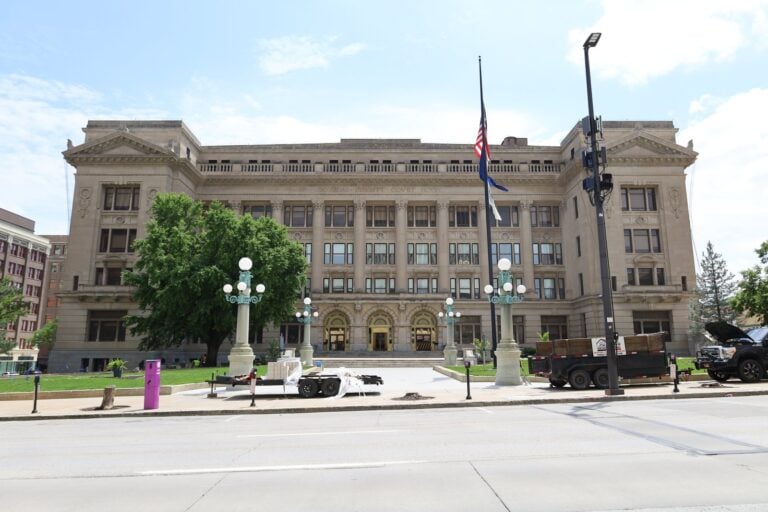
Photo: Douglas County Courthouse, Omaha. Photo by shannonpatrick17 / Wikimedia Commons, licensed CC BY 2.0. Source: https://commons.wikimedia.org/wiki/File:Douglas_County_Nebraska_Courthouse.jpg
Sources
- Legal Aid of Nebraska, “Debt and Finance”: https://legalaidofnebraska.org/what-we-do/debt-and-finance.html
- Neb. Rev. Stat. § 25-503.01: https://nebraskalegislature.gov/laws/statutes.php?statute=25-503.01
- Nebraska Judicial Branch, “Nebraska Increases Jurisdictional Limits for Small Claims and County Courts,” June 20, 2025: https://nebraskajudicial.gov/administration/news/nebraska-increases-jurisdictional-limits-small-claims-and-county-courts
- Nebraska Judicial Branch, “Case Information – eServices”: https://nebraskajudicial.gov/e-services/case-information-eservices
- Neb. Ct. R. Pldg. § 6-1112: https://nebraskajudicial.gov/supreme-court-rules/chapter-6-trial-courts/article-11-nebraska-court-rules-pleading-civil-cases-effective-january-1-2025/%C2%A7-6-1112-defenses-and-objections-when-and-how-presented-pleading-or-motion-motion-judgment-pleadings
- Neb. Rev. Stat. § 25-2704: https://nebraskalegislature.gov/laws/statutes.php?statute=25-2704
- Nebraska Judicial Branch, “Self-Help”: https://nebraskajudicial.gov/self-help
- Neb. Ct. R. Pldg. § 6-1108: https://nebraskajudicial.gov/supreme-court-rules/chapter-6-trial-courts/article-11-nebraska-court-rules-pleading-civil-cases-effective-january-1-2025/%C2%A7-6-1108-general-rules-pleading
- Nebraska State Court Form CC 3:18, “Answer and General Denial”: https://nebraskajudicial.gov/sites/default/files/CC-3-18.pdf
- Neb. Ct. R. § 6-1432: https://nebraskajudicial.gov/supreme-court-rules/chapter-6-trial-courts/article-14-uniform-county-court-rules-practice-and-procedure/%C2%A7-6-1432-default-judgments
- Legal Aid of Nebraska, “Call for Help”: https://legalaidofnebraska.org/call-for-help.html
- Nebraska Judicial Branch, “Legal Resources & Information”: https://nebraskajudicial.gov/self-help/legal-resources-information
- Neb. Rev. Stat. § 24-517 (Jurisdiction), subdivision (5): https://nebraskalegislature.gov/laws/statutes.php?statute=24-517