By Oversight Justice Staff | Nov. 14, 2026
Police in downtown Omaha did not turn a drunken-driving investigation into an arrest when they drove a driver three or four blocks to a parking garage attached to police headquarters for field sobriety tests, the Nebraska Supreme Court ruled Nov. 13. But the court also warned that bad weather “will not justify transporting a suspect under all circumstances.” Here is what the court decided, the test it used, and what Nebraska law says about breath tests during a traffic stop.
Disclosure: Oversight Justice is owned by David Mitchell, who founded the site and also owns Gamers Hub LLC, which operates as Go Gamers. Mitchell sued Douglas County, the City of Omaha, Douglas County Attorney Don Kleine and others in federal court (Mitchell v. County of Douglas, No. 8:23-cv-00332, D. Neb.). The court dismissed the suit on April 12, 2024, on several grounds, including immunity and failure to state a claim; the 8th U.S. Circuit Court of Appeals affirmed on Feb. 5, 2025. See our About page.
What happened
The case, State v. Saunsoci, began with a traffic stop on Feb. 11, 2025, according to the court’s opinion. Two uniformed officers in a marked cruiser were on patrol in the Old Market area of downtown Omaha. At about 8:45 p.m. at 11th and Howard streets, they saw a car they said was “traveling at a pace that is above the normal pace” toward a stop sign and had “no plates and no visible in-transits” that they could see. They stopped it.
The driver told an officer she did not have a driver’s license. The officers said she seemed confused and had trouble giving her ZIP code. One officer said, “I don’t smell anything, but she’s acting awful weird.” She said she had not been drinking but had taken “weed . . . little edible things” earlier in the day. A records check showed three prior DUI convictions and a revoked license, the opinion says.
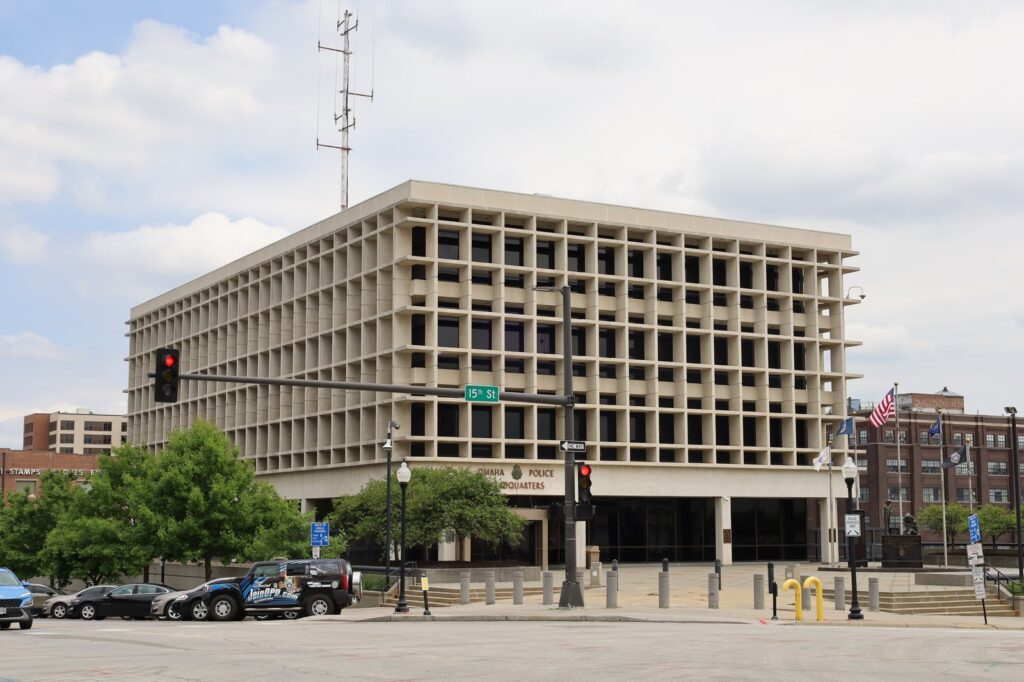
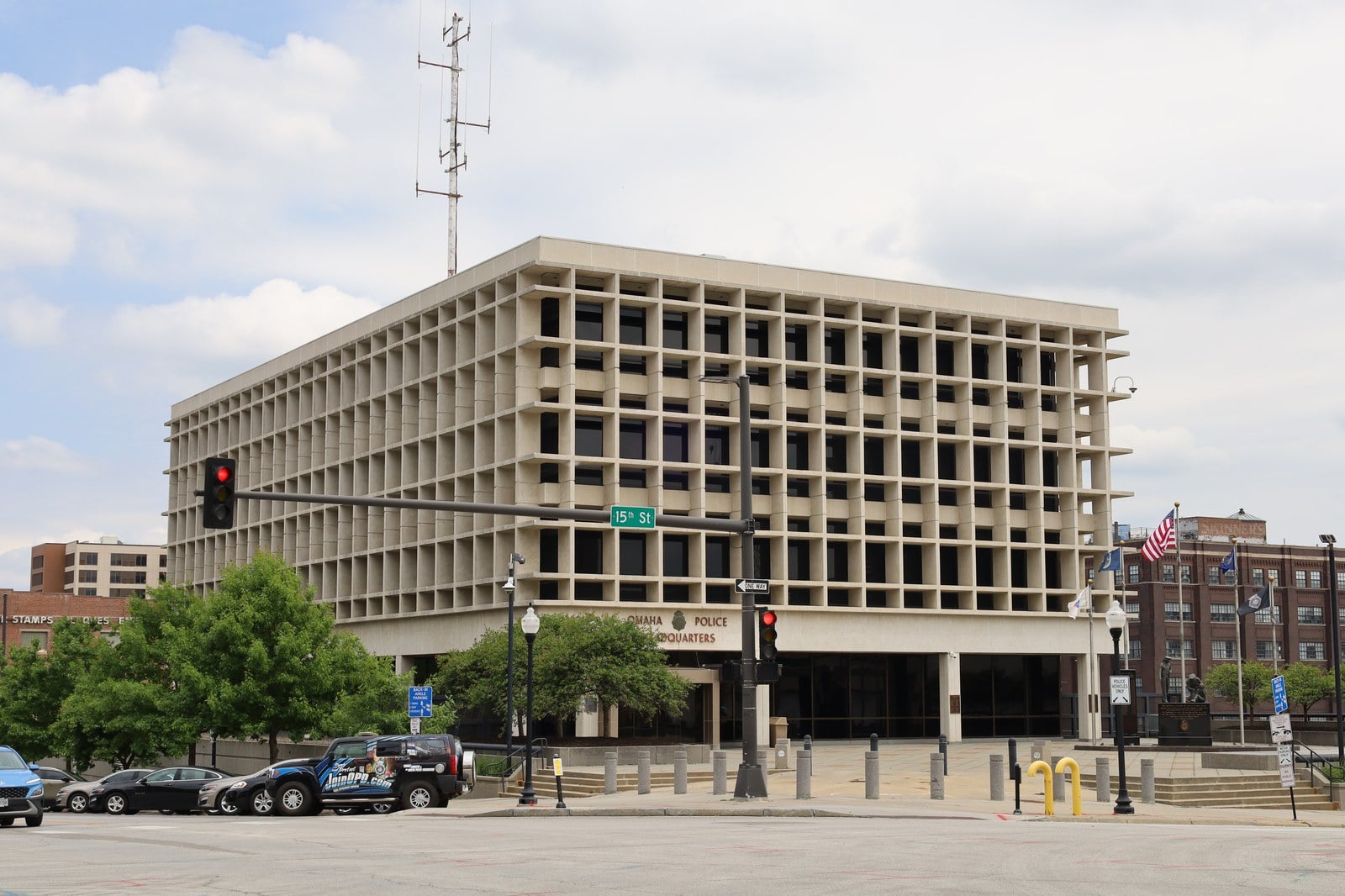
It was snowing, and one officer testified that the temperature was “like, 10 degrees.” The officers did not want to give walking and balance tests on the cobblestone street. The officers had already put the driver in their cruiser to get her out of the weather. They drove her to the parking garage at police headquarters, which an officer said was “three or four blocks” away. They entered through a secured entrance that only police could use. One officer testified that driving people to the garage for the tests in rain, snow or ice was normal.
The driver was not handcuffed on the way or during the tests, the opinion says. In the garage, an officer noticed a “moderate smell of alcohol.” A preliminary breath test showed a breath alcohol concentration of .165. Officers then arrested and handcuffed her and took her inside headquarters, where a DataMaster breath test showed .128. Nebraska’s legal limit is .08 (Neb. Rev. Stat. § 60-6,196).
Before trial, the driver asked the Douglas County District Court to throw out the evidence. She argued that once officers moved her to police headquarters, the stop became an arrest, and they did not have probable cause to arrest her at that point. District Judge Molly B. Keane denied the motion, finding the garage “was instead a convenient, dry location for field sobriety tests.” After a bench trial, the judge found her guilty of DUI, fourth offense, and sentenced her to 90 days’ imprisonment, a $2,000 fine, three years of probation and a 15-year license revocation. The Douglas County Public Defender’s office handled the appeal.
What the Supreme Court decided
The Nebraska Supreme Court affirmed the conviction. Justice Bergevin wrote the opinion; no justice wrote separately. The court said:
- No bright-line rule. The driver relied on U.S. Supreme Court cases holding that when police “forcibly remove a person from his home or other place in which he is entitled to be and transport him to the police station” for investigation, the seizure is “sufficiently like arrests” to require probable cause (Hayes v. Florida, 1985). The Nebraska court said those cases involved people taken from their homes for things like fingerprinting and interrogation. “[W]e determine that there is no bright-line rule that transporting Saunsoci raised the level of the encounter to an arrest,” it wrote.
- Safety can justify a move. The court relied on the U.S. Supreme Court’s statement in Florida v. Royer (1983, plurality opinion) that “there are undoubtedly reasons of safety and security that would justify moving a suspect from one location to another during an investigatory detention.”
- The facts here. The drive took “only a few minutes.” The tests in the garage took about 10 minutes, and the whole encounter, from the stop to the end of the tests, took about 35 minutes. Officers used only DUI-investigation steps, not fingerprinting or a room for interrogation, and did no full search before or during the transport. The garage was “a parking area for vehicles and not a place for detaining persons.” An officer testified that the driver could have left the garage on her own if she had not been detained.
The court concluded that moving her “was within the scope of the investigative detention and did not transform the encounter into an arrest requiring probable cause.” Because of that, it did not decide whether officers already had probable cause to arrest her before the transport.
The limits the court set
The opinion includes a warning: “we do not think that merely identifying safety and security concerns based on weather conditions is sufficient to show that transporting a suspect is within the scope of an investigative detention.” It added: “We therefore caution that unfavorable weather conditions will not justify transporting a suspect under all circumstances.”
The court also noted that a Utah case it relied on was different in one “significant aspect”: there, the driver agreed to be moved. “There is no evidence in this case that the officers sought consent or that Saunsoci gave her consent to be transported,” the court wrote.
Courts judge each case on its facts. In deciding whether a stop has become an arrest, the court said, judges look at “(1) the law enforcement purposes served by the detention, (2) the diligence with which law enforcement pursues the investigation, (3) the scope and intrusiveness of the detention, and (4) the duration of the detention.” Police may not “attempt to verify their suspicions by means that approach the circumstances of an arrest,” and the methods used “should be the least intrusive means reasonably available to verify or dispel the officer’s suspicion in a short period of time.”
The rules for a traffic stop, as the court described them
- A traffic stop is a seizure under the Fourth Amendment. “A traffic violation, no matter how minor, creates probable cause to stop the driver of a vehicle.”
- “A lawful traffic stop can become unlawful if it is prolonged beyond the time reasonably required to complete the mission of the stop.”
- To keep a driver for field sobriety tests, an officer needs only “a reasonable, articulable suspicion” that the person was driving under the influence. That is “something more than an inchoate and unparticularized hunch, but less than the level of suspicion required for probable cause.”
- An arrest requires probable cause.
What Nebraska law says about breath tests
- Preliminary breath test: An officer may require a driver to take a preliminary breath test if the officer “has reasonable grounds to believe that such person has alcohol in his or her body, has committed a moving traffic violation, or has been involved in a traffic accident.” A person who refuses, or whose result is over the legal limit, “shall be placed under arrest.” Refusing is a Class V misdemeanor. (Neb. Rev. Stat. § 60-6,197.04)
- Implied consent: Anyone who drives in Nebraska “shall be deemed to have given his or her consent” to a chemical test of blood, breath or urine. After an arrest for DUI, an officer with reasonable grounds may require the test. Refusing can lead to administrative license revocation and is itself a crime. (Neb. Rev. Stat. § 60-6,197)
This article is not legal advice.
Why it matters
The ruling means Nebraska police can, in some situations, move a person they have stopped to another place, including a garage at police headquarters, without that move counting as an arrest. The court tied its decision to the facts of this case: snow and cold, a short drive, prompt tests, no handcuffs, and a garage rather than a jail or interview room. It said weather alone will not always be enough. Future cases will decide where the line falls.
Related: Nebraska Supreme Court rejects new challenge to cellphone ‘tower dump’ evidence, What Omaha police publish about use of force and How to look up a Nebraska court case.
Disclosure: Oversight Justice is owned by David Mitchell, who founded the site and also owns Gamers Hub LLC, which operates as Go Gamers. Mitchell sued Douglas County, the City of Omaha, Douglas County Attorney Don Kleine and others in federal court (Mitchell v. County of Douglas, No. 8:23-cv-00332, D. Neb.). The court dismissed the suit on April 12, 2024, on several grounds, including immunity and failure to state a claim; the 8th U.S. Circuit Court of Appeals affirmed on Feb. 5, 2025. See our About page.
Sources
- Nebraska Supreme Court, State v. Saunsoci, 322 Neb. 809 (filed Nov. 13, 2026), No. S-25-966
- Nebraska Supreme Court, Supreme Court Opinions list (Nov. 13, 2026 releases)
- U.S. Supreme Court, Hayes v. Florida, 470 U.S. 811 (1985) (Library of Congress, U.S. Reports)
- U.S. Supreme Court, Florida v. Royer, 460 U.S. 491 (1983) (Library of Congress, U.S. Reports)
- Nebraska Legislature, Neb. Rev. Stat. § 60-6,196
- Nebraska Legislature, Neb. Rev. Stat. § 60-6,197
- Nebraska Legislature, Neb. Rev. Stat. § 60-6,197.04
- Wikimedia Commons: Omaha Police Headquarters 2025.jpg (photo and license)